Before we automate the work, question the handovers.
AI may change the limits that shaped our organisations. The harder question is which handovers carry information—and which carry judgement we cannot afford to lose.
BY ROB OTERO / FORO
I’ve spent much of my career working out what capabilities businesses need to grow and how to bring them together to keep the flywheel turning.
As I get closer to AI and future operating models—rethinking existing businesses and designing new ones—I’m questioning why we distribute work as we do.
We divide it into specialist functions, each holding different expertise and information. Then we build processes to connect them. But those processes should earn their place through the outcomes they deliver.
So I’ve begun to ask myself: how much of what we call “work” is actually just moving knowledge around?
(Is it just me, or did that sound like Carrie Bradshaw?)
Five functions. One decision.
A conversation last week about hiring brought this into focus.
The manager knows the need. Finance knows the budget and current performance. Compensation holds the salary benchmarks. Recruitment knows the market. People Operations knows the approval process.
Get everyone in a room and much of this might take an hour. Instead, it takes weeks of emails, meetings and handovers. Frustration increases. Decision quality doesn’t necessarily follow.
Part of that coordination exists because our decisions are constrained by the information, time and processing capacity available to us. Herbert Simon called this bounded rationality.
Could an AI agent loosen those bounds by connecting knowledge spread across five functions, surfacing inconsistencies and challenging the proposed hire?
My perspective: we should question the handovers before we automate the tasks. Otherwise, we make every step faster while preserving a process that no longer needs so many steps.
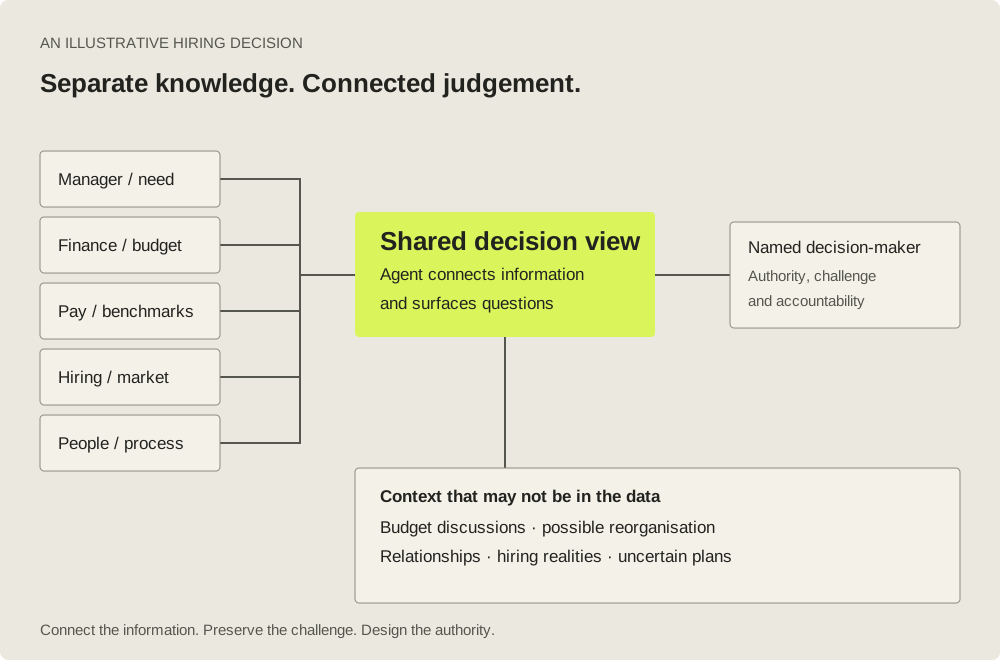
A possible design for a hiring decision. Connecting information can reduce handovers; context, challenge and accountability still need explicit places in the process.
More information. Enough context?
But there’s a catch.
Finance knows the budget exists—and that reallocating it is being discussed. The HR partner knows a reorganisation may be coming. Recruitment knows this manager is difficult to work for.
None of that necessarily appears in the data.
An agent might have more information than any individual. Does it have the context to make a better decision?
Designing for justified trust.
At Penrose, we’re exploring what this means for operating models: which constraints AI changes, where human judgement matters, and who has authority and accountability.
Increasingly, that means asking how we give agents richer context—and what controls and evidence would justify trusting them with more responsibility.
I suspect the future operating model will be shaped as much by what we trust AI to do as by what it’s capable of doing.
Which handover in your business could disappear tomorrow—and what would you lose if it did?
Further reading: Herbert A. Simon, Rational Decision-Making in Business Organizations, Nobel lecture, 1978.