What steel slag taught me about assumptions.
An acquisition early in my career changed how I look at opportunities we think we’ve already assessed.
BY ROB OTERO / FORO
Some of the experiences that shape how you think come from unexpected places. One of mine involved steel slag.
During my time at Harsco, I was involved in acquisition work around Excell Materials, a Pittsburgh-based business with technology for recovering valuable metal from steelmaking slag. Harsco acquired it in 2007.
My role was in understanding processes, risks and what bringing the business into Harsco would involve. It also gave me a view of the commercial logic behind the deal.
Excell could recover nickel-bearing material for reuse in steel production, including from existing slag stockpiles. It also developed commercial uses for the remaining mineral material, from agricultural products to construction applications.
What caught my attention was how the economics could change the way you looked at something already sitting there.
Nickel prices had risen sharply. The annual average increased from roughly $14,700 per tonne in 2005 to $25,000 in 2006. Alongside the recovery capability, that created a different commercial equation.
The acquisition was a strategic response to the opportunity. For me, it was an early lesson in why an assessment has a shelf life.
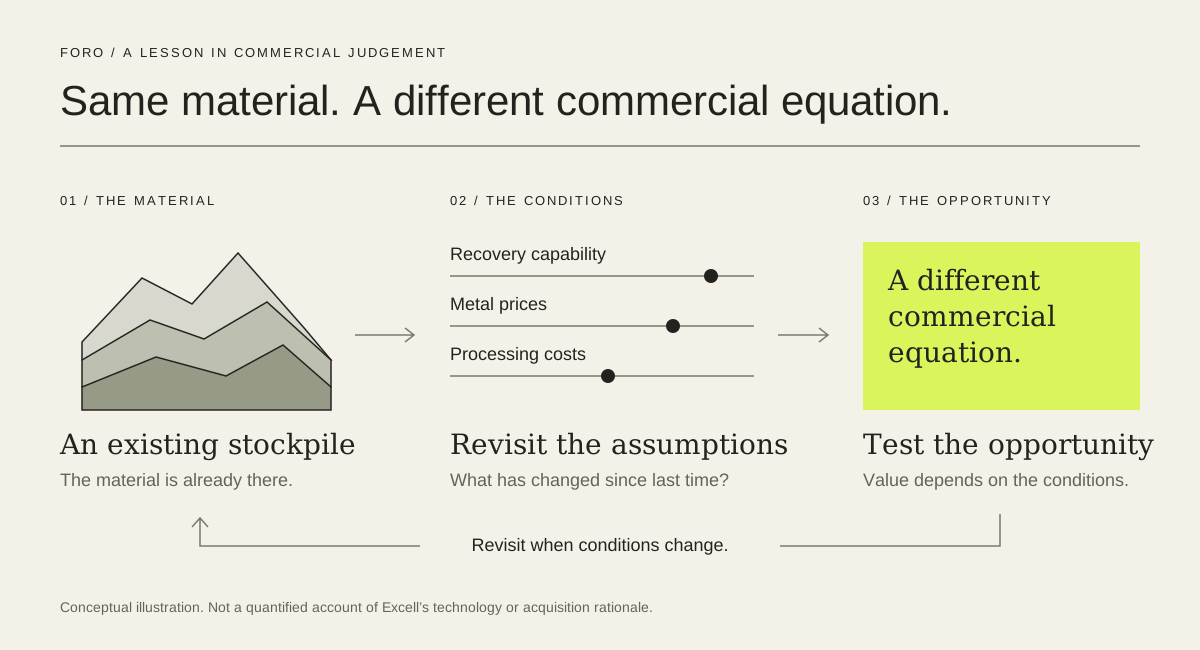
What changed since we last looked?
Businesses accumulate conclusions.
Too expensive. Too difficult. Too small to matter. We looked at that before.
Those conclusions may have been entirely sensible when they were reached. But they depend on assumptions about prices, costs, capabilities, demand and timing.
The conclusion often survives in organisational memory long after anyone remembers the assumptions underneath it.
That is what stayed with me from Excell: the importance of returning to the equation.
What made this unattractive before? Which conditions have changed? Does the old answer still hold?
There is a second part to the story, too. Nickel prices peaked above $54,000 per tonne in May 2007, then fell to around $9,000 by December 2008. The same discipline has to work in both directions. An opportunity supported by favourable economics still needs to be tested when those economics turn.
It helped form a habit I’ve carried into very different industries.
When someone says, “We’ve already looked at that,” I want to understand what they found—and what would need to be true for the answer to change.
Sometimes the opportunity is new. Sometimes we need to look again.